
Idea signal: 20 Realistic Side Hustles for 2026 – NerdWallet
If you are searching for a side hustle you can start without much money, the honest answer is usually less exciting than the internet makes it sound. You do not need a secret loophole. You need a small problem people already have, a simple way to help them, and a repeatable system for getting in front of those people. That is the lens for this IdeaVaultHQ post.
This idea came from a public demand signal on RSS / search trend. I am not using that signal as something to copy. I am using it the way a small business owner would use a conversation at a coffee shop: as proof that real people are asking for help around a topic. From there, the goal is to build an original, practical side hustle around the problem.
The side hustle for today is a tiny digital-help service that can later turn into products: take one messy task people do not want to finish, clean it up for a small fee, then package your process into a template, checklist, or mini guide. This can apply to resumes, flyers, captions, product descriptions, budgeting sheets, job-search trackers, simple website audits, or local business content.
Today’s angle: beginner setup plan. If this idea appears again, IdeaVaultHQ will treat it from a different angle so the blog keeps building a useful library instead of repeating itself.
What This Side Hustle Is
The basic offer is simple: “I will help you finish this small task today.” That is it. Not a giant agency. Not a complicated software company. Not a course promising huge money. A tiny service that solves a tiny headache.
Examples include rewriting a resume summary, making ten social media captions for a cleaner, turning a messy business description into polished copy, creating a one-page flyer draft, cleaning up an Etsy product description, or building a simple checklist for someone who keeps asking the same question.
This kind of offer matters because beginners often get stuck trying to build passive income before they have any proof that people want what they are making. A small service gets you closer to the market. You hear the exact words people use. You learn what they are willing to pay for. Then you can turn the repeated parts into a digital product.
Who This Is For
This is for someone starting with little or no money who can write clearly, organize information, use free tools, and follow instructions. You do not need to be a professional designer or developer. You do need to be reliable. If you say you will send a draft today, send the draft today.
It is also for people who like practical, small wins. If your first target is $5 a day, you do not need a thousand visitors. You need one tiny paid task, one small product sale, or one useful offer that somebody understands quickly.
The best beginner categories are boring in a good way: job search help, local business content, cleaning business flyers, simple spreadsheets, marketplace descriptions, short captions, checklists, and templates. These are not glamorous topics, but they are close to real problems.
Why People Pay For It
People pay when a task is annoying, urgent, or slightly outside their comfort zone. A resume is personal and stressful. A flyer has to look good enough to hand out. A product description has to sound clear enough to make a buyer trust the listing. A small business owner may know their work, but still struggle to explain it online.
That is where a beginner-friendly service can work. You are not selling magic. You are selling relief. You are saying, “I can take this messy thing and make the first version cleaner.”
The price can be low at first because the task is small. A $5 to $15 offer is easier to sell than a $500 package when nobody knows you yet. Once you have examples, reviews, and a repeatable process, you can raise prices or bundle the work.

How To Start With Little Or No Money
Start with free tools. Use Google Docs for writing, Google Sheets for trackers, Canva for simple flyer layouts, and a free form tool for intake. If you already have a WordPress site, publish helpful posts around each problem you solve. Each post becomes a search engine doorway for people who are already looking for the answer.
Pick one offer for the first week. Do not offer everything at once. A good first offer might be “I will clean up your resume summary for $5” or “I will write ten captions for your local service business for $10.” The more specific the offer, the easier it is for someone to say yes.
Make a sample before anyone pays. For example, create a before-and-after resume summary using fake details, a sample cleaning flyer, or a sample Etsy description. This gives people confidence without requiring a portfolio full of past clients.
Where To Find Your First Customers
You do not need to wait for Google traffic in the beginning. Look for public places where people are already asking questions. Reddit, local Facebook groups where promotion is allowed, Craigslist gigs, community boards, job-search communities, and small business forums can all reveal demand.
The right approach is not to blast spam messages. The right approach is to answer naturally, be useful, and offer a small next step. A good reply sounds like a person, not an ad. For example: “I can help tighten the wording on this. If you send the job title, I can make the summary more focused.”
Over time, your blog posts do a second job. They let search engines understand what IdeaVaultHQ is about: practical side hustles, AI-assisted work, digital products, and low-cost business ideas. That organic traffic takes time, but every useful post is another chance to be found.
The Organic Search Angle
To earn search traffic, a post should answer one specific question better than a thin listicle. Instead of writing “100 Side Hustles to Try,” write posts like “How to Make Your First $5 Selling Resume Cleanup Help” or “How to Turn Cleaning Business Captions Into a Tiny Digital Product.” Specific posts are easier to rank for because they match a real search intent.
Each article should include the exact beginner question, the simple answer, steps, tools, examples, and warnings. Search engines are not just looking for keywords. They are trying to satisfy the searcher. If someone lands on the page and immediately understands what to do next, the post is doing its job.
Use natural phrases people search for: side hustle with no money, make $5 a day online, beginner digital product, local business content service, AI side hustle, simple online gig, and how to start with free tools. Do not stuff the phrases. Put them where they actually help the reader.
How To Automate Part Of It
The automation should help you move faster without turning the work into spam. A good bot can collect public idea signals, rank them, draft replies, write blog outlines, create product ideas, and prepare first drafts. You still want a final review before sending messages or publishing anything sensitive.
For this side hustle, automation can handle the daily research. It can look for repeated questions around resumes, flyers, captions, budget sheets, local service marketing, AI tools, and online gigs. When the same problem appears again and again, that is a signal for a blog post or product.
Automation can also create the first version of the deliverable. If the job is caption writing, it can draft the captions. If the job is a checklist, it can build the checklist. If the job is an audit, it can create the first audit structure. Your job becomes reviewing, improving, and making the final answer feel human.
What A Real Starter Offer Looks Like
To make this idea real, define one tiny offer with a deliverable, a turnaround time, and a result a buyer can understand in one sentence. A vague offer like “help with digital stuff” is hard to sell. A clear offer like “I will clean up your resume summary and write a tailored first paragraph” is much easier.
Here are simple examples that fit the same model. A job seeker offer can be a resume summary rewrite plus three bullet suggestions. A local business offer can be ten caption ideas plus a basic posting calendar. An Etsy seller offer can be a title and description cleanup for five listings. A budgeting offer can be a starter sheet with formulas and a one-page instructions tab. A community group offer can be a flyer draft and a short event blurb.
The key is to keep the promise narrow. You are not trying to solve every problem the customer has. You are delivering one useful outcome fast. That speed matters because people often pay for convenience, not complexity. If the task feels small enough to finish in an evening, it is likely a good starter offer.
Package the offer so the buyer knows what happens next. Say what information you need, what file format they get, when they get it, and how many revisions you allow. A tiny service becomes much easier to sell when the buyer can picture the process. It also becomes easier for you to automate because every order follows the same steps.
One practical model is a three-part offer ladder. The starter version is a $5 or $10 fix. The middle version is a bundle with a little more customization. The larger version is the same work plus a template or instructions so the buyer can repeat it themselves. That ladder lets you start simple and raise the value without inventing a completely new business.
If you are unsure what to sell, look at the tasks people keep postponing. Those are often the best starter offers. They are not glamorous, but they are annoying enough that someone will pay to get them off their plate. That is the kind of demand signal this bot is designed to notice.
Copy-Paste ChatGPT Prompt
Use this prompt to turn the idea into a small automated workflow:
You are my side-hustle assistant. Help me turn this idea into a simple money-making offer: 20 Realistic Side Hustles for 2026 - NerdWallet

Create:
1. A clear $5 to $15 starter offer
2. The exact person who would buy it
3. A simple delivery checklist
4. A short message I can send to potential customers
5. A reusable template or digital product version
6. A 7-day action plan to get the first sale

Keep it realistic, beginner-friendly, and focused on free tools.
First $5/Day Plan
Day one: choose one tiny offer and write a sample. Day two: publish a blog post explaining the problem and your solution. Day three: answer five public questions where your offer is relevant. Day four: turn your best answer into a reusable template. Day five: post the template or offer again, with a clear $5 starting price.
The math is simple. One $5 sale per day hits the first target. One $10 task every other day also gets close. The goal at this stage is not to replace a job. The goal is proof. If one person pays, you know the idea is not imaginary.
Once you get three to five similar requests, stop and ask: can this become a product? If yes, make the product. A resume service can become a resume checklist. Caption work can become a caption pack. Flyer work can become a Canva flyer template. The service teaches you what the product should be.

Risks And Warnings
Do not promise guaranteed income. A side hustle is not guaranteed money. It is a small experiment. Some posts will get ignored. Some offers will need to be rewritten. Some ideas will be too competitive or too vague.
Do not scrape private content or copy someone else’s work. Use public signals as research, then write original posts and make original deliverables. Do not send mass direct messages. Do not do fake reviews, shady account work, or anything that asks for bank access, crypto transfers, or upfront payments from you.
Also watch your time. If a $5 task takes three hours, the offer is broken. Either simplify the task, raise the price, or turn it into a product instead of a service.
Next Steps Checklist
- Pick one small problem people already ask about.
- Create one sample result using free tools.
- Write one helpful blog post around that problem.
- Reply to five public opportunities without spamming.
- Offer a tiny paid version for $5 to $15.
- Track every repeated request as a future product idea.
- Turn the most repeated request into a template, checklist, or mini guide.
Final Take
The most realistic beginner side hustle is not always the flashiest. It is often a tiny service attached to a real problem. Start with helping one person finish one annoying task. Then use what you learn to build content, templates, and products around that same problem.
That is how a small $5/day target can turn into something bigger. You are not trying to guess the perfect business. You are building a habit of noticing demand, publishing helpful answers, and turning repeated problems into assets.
Source Signal
Continue Learning On IdeaVaultHQ
This guide is part of the IdeaVaultHQ Template School path. Use the links below to keep moving instead of stopping on one article.
Success Diagram For This Idea
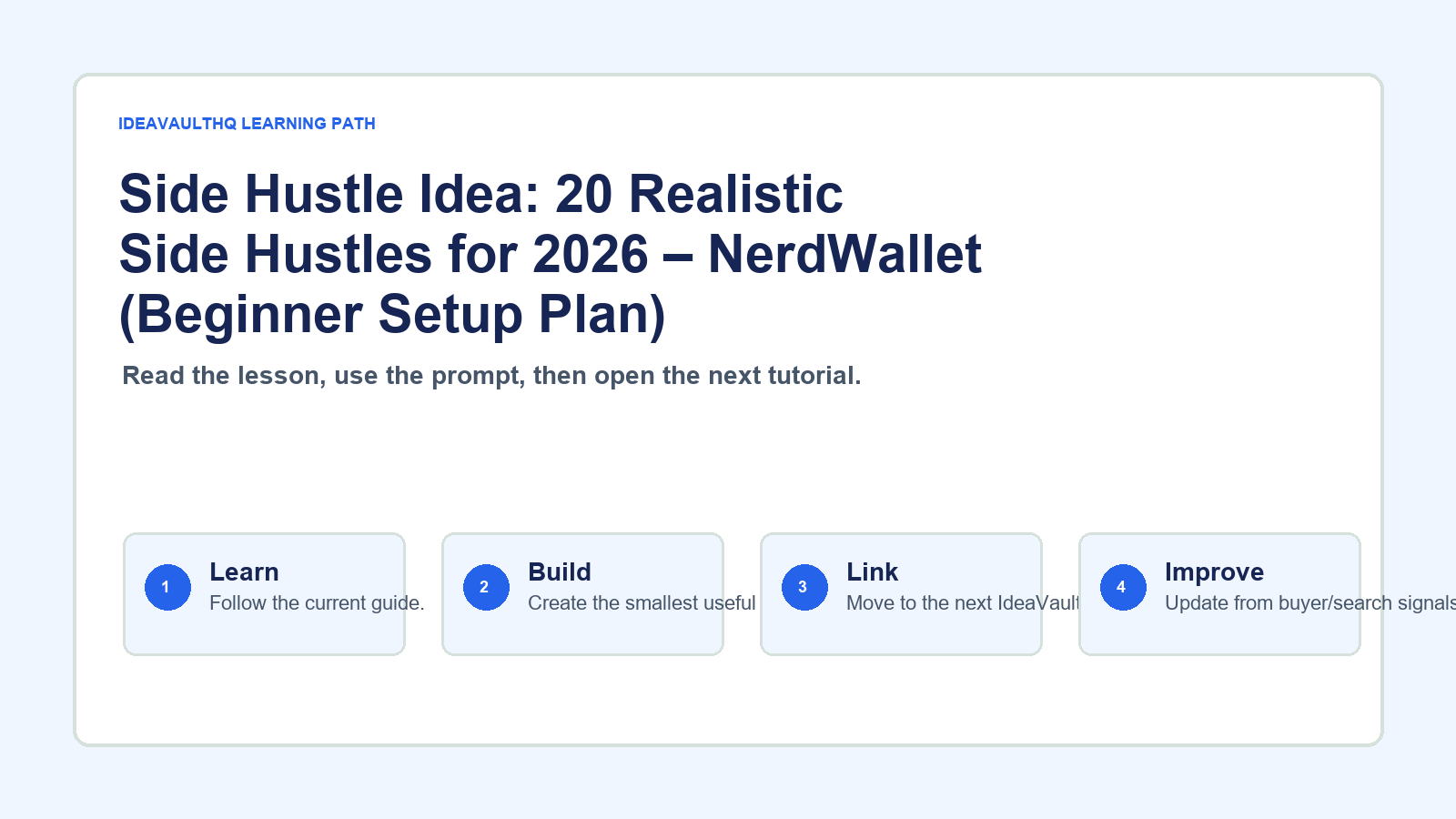
This is the practical path from reading Side Hustle Idea: 20 Realistic Side Hustles for 2026 – NerdWallet (Beginner Setup Plan) to turning the idea into a small testable offer.
Leave a Reply